Задачи на функции работы со строками в javascript
Содержание:
- JavaScript strings
- reduce/reduceRight
- Что с олеофобным покрытием делают защитные стёкла
- Array.isArray
- The separator criteria
- The split method syntax
- Добавление/удаление элементов
- Удаление элементов
- The limit criteria
- Внутреннее устройство массива
- Split string in two on a given index
- How to Use JQuery?
- How to split a string
- Массивы в JavaScript
- # What is Splitting?
- # Installation
- String Primitives and String Objects
- Ручная установка графического драйвера Nvidia тоже осуществляется несложно
- concat
JavaScript strings
The string in JavaScript allows you to store information within a string or an object. The information that can be stored includes text, white spaces, digits and other special text characters. Formatting character like tabs, carriage returns and new line characters can also be stored within the string or object. Properties of a string include the length, prototype and constructor properties.
The string object has a number of methods that can be applied to it to allow for manipulation of the string or string object. String methods include the match(), replace(), search() , slice() and split() methods. Methods are essentially programs that manipulate objects in a predefined way.
Strings are generally stored as a variable within JavaScript code. Here are some examples of strings
var string1 = "This is a string"; var string2 = "john2@email.co.za"; var string2 = "john2@email.co.za"; var string3 = "Mr. John Adams"; var string4 = "He is called \"John\""; |
reduce/reduceRight
Метод «arr.reduce(callback)» используется для последовательной обработки каждого элемента массива с сохранением промежуточного результата.
Это один из самых сложных методов для работы с массивами. Но его стоит освоить, потому что временами с его помощью можно в несколько строк решить задачу, которая иначе потребовала бы в разы больше места и времени.
Метод используется для вычисления на основе массива какого-либо единого значения, иначе говорят «для свёртки массива». Чуть далее мы разберём пример для вычисления суммы.
Он применяет функцию по очереди к каждому элементу массива слева направо, сохраняя при этом промежуточный результат.
Аргументы функции :
- – последний результат вызова функции, он же «промежуточный результат».
- – текущий элемент массива, элементы перебираются по очереди слева-направо.
- – номер текущего элемента.
- – обрабатываемый массив.
Кроме , методу можно передать «начальное значение» – аргумент . Если он есть, то на первом вызове значение будет равно , а если у нет второго аргумента, то оно равно первому элементу массива, а перебор начинается со второго.
Проще всего понять работу метода на примере.
Например, в качестве «свёртки» мы хотим получить сумму всех элементов массива.
Вот решение в одну строку:
Разберём, что в нём происходит.
При первом запуске – исходное значение, с которого начинаются вычисления, равно нулю (второй аргумент ).
Сначала анонимная функция вызывается с этим начальным значением и первым элементом массива, результат запоминается и передаётся в следующий вызов, уже со вторым аргументом массива, затем новое значение участвует в вычислениях с третьим аргументом и так далее.
Поток вычислений получается такой
В виде таблицы где каждая строка – вызов функции на очередном элементе массива:
| результат | |||
|---|---|---|---|
| первый вызов | |||
| второй вызов | |||
| третий вызов | |||
| четвёртый вызов | |||
| пятый вызов |
Как видно, результат предыдущего вызова передаётся в первый аргумент следующего.
Кстати, полный набор аргументов функции для включает в себя , то есть номер текущего вызова и весь массив , но здесь в них нет нужды.
Посмотрим, что будет, если не указать в вызове :
Результат – точно такой же! Это потому, что при отсутствии в качестве первого значения берётся первый элемент массива, а перебор стартует со второго.
Таблица вычислений будет такая же, за вычетом первой строки.
Метод arr.reduceRight работает аналогично, но идёт по массиву справа-налево.
Что с олеофобным покрытием делают защитные стёкла
Array.isArray
Массивы не
образуют отдельный тип языка. Они основаны на объектах. Поэтому typeof не может
отличить простой объект от массива:
console.log(typeof {}); // object
console.log (typeof ); // тоже object
Но массивы
используются настолько часто, что для этого придумали специальный метод: Array.isArray(value). Он возвращает
true, если value массив, и false, если нет.
console.log(Array.isArray({})); // false
console.log(Array.isArray()); // true
Подведем итоги
по рассмотренным методам массивов. У нас получился следующий список:
|
Для |
|
|
push(…items) |
добавляет элементы в конец |
|
pop() |
извлекает элемент с конца |
|
shift() |
извлекает элемент с начала |
|
unshift(…items) |
добавляет элементы в начало |
|
splice(pos, deleteCount, …items) |
начиная с индекса pos, удаляет |
|
slice(start, end) |
создаёт новый массив, копируя в него |
|
concat(…items) |
возвращает новый массив: копирует все |
|
Для поиска |
|
|
indexOf/lastIndexOf(item, pos) |
ищет item, начиная с позиции pos, и |
|
includes(value) |
возвращает true, если в массиве |
|
find/filter(func) |
фильтрует элементы через функцию и |
|
findIndex(func) |
похож на find, но возвращает индекс |
|
Для перебора |
|
|
forEach(func) |
вызывает func для каждого элемента. |
|
Для |
|
|
map(func) |
создаёт новый массив из результатов |
|
sort(func) |
сортирует массив «на месте», а потом |
|
reverse() |
«на месте» меняет порядок следования |
|
split/join |
преобразует строку в массив и обратно |
|
reduce(func, initial) |
вычисляет одно значение на основе |
Видео по теме
JavaScipt #1: что это такое, с чего начать, как внедрять и запускать
JavaScipt #2: способы объявления переменных и констант в стандарте ES6+
JavaScript #3: примитивные типы number, string, Infinity, NaN, boolean, null, undefined, Symbol
JavaScript #4: приведение типов, оператор присваивания, функции alert, prompt, confirm
JavaScript #5: арифметические операции: +, -, *, /, **, %, ++, —
JavaScript #6: условные операторы if и switch, сравнение строк, строгое сравнение
JavaScript #7: операторы циклов for, while, do while, операторы break и continue
JavaScript #8: объявление функций по Function Declaration, аргументы по умолчанию
JavaScript #9: функции по Function Expression, анонимные функции, callback-функции
JavaScript #10: анонимные и стрелочные функции, функциональное выражение
JavaScript #11: объекты, цикл for in
JavaScript #12: методы объектов, ключевое слово this
JavaScript #13: клонирование объектов, функции конструкторы
JavaScript #14: массивы (array), методы push, pop, shift, unshift, многомерные массивы
JavaScript #15: методы массивов: splice, slice, indexOf, find, filter, forEach, sort, split, join
JavaScript #16: числовые методы toString, floor, ceil, round, random, parseInt и другие
JavaScript #17: методы строк — length, toLowerCase, indexOf, includes, startsWith, slice, substring
JavaScript #18: коллекции Map и Set
JavaScript #19: деструктурирующее присваивание
JavaScript #20: рекурсивные функции, остаточные аргументы, оператор расширения
JavaScript #21: замыкания, лексическое окружение, вложенные функции
JavaScript #22: свойства name, length и методы call, apply, bind функций
JavaScript #23: создание функций (new Function), функции setTimeout, setInterval и clearInterval
The separator criteria
Let us add a criterion to the split function to split our string. As mentioned, any characters can be used as the split criteria. In our first split example, we will set whitespaces as the criteria by setting whitespaces as the criteria within quotation marks. Take a look at the next example:
<html>
<body>
<script type="text/javascript">
// Create a variable that contains a string
var myString = "Mr. Jack Adams";
// Create a variable to contain the array
var mySplitResult;
// Use the string.split function to split the string
// using the whitespaces as a criteria for splitting the string
mySplitResult = myString.split(" ");
for(i = 0; i < mySplitResult.length; i++)
           {
  document.write("<br /> Element " + i + " of the array is: " + mySplitResult);
           }
</script>
</body>
</html>
|
The program would split the string each time it found a white space within the string. The output of the above would therefore be:
Element 0 of the array is: Mr. Element 1 of the array is: Jack Element 2 of the array is: Adams |
If we wanted to split the string using each character within the string then we could use empty quotation marks. This is what the code looks like to split each character within the string
<html>
<body>
<script type="text/javascript">
// Create a variable that contains a string
var myString = "Mr. Jack Adams";
// Create a variable to contain the array
var mySplitResult;
// Use the string.split function to split the string
// using empty quotation marks as a criteria for splitting the string
mySplitResult = myString.split("");
for(i = 0; i < mySplitResult.length; i++)
           {
  document.write("<br /> Element " + i + " of the array is: " +  |
      mySplitResult);
           }
</script>
</body>
</html>
|
As you can see from the output below, each character within the string has become a separate element within the array. The output of the above would be:
Element 0 of the array is: M Element 1 of the array is: r Element 2 of the array is: . Element 3 of the array is: Element 4 of the array is: J Element 5 of the array is: a Element 6 of the array is: c Element 7 of the array is: k Element 8 of the array is: Element 9 of the array is: A Element 10 of the array is: d Element 11 of the array is: a Element 12 of the array is: m Element 13 of the array is: s |
You could also use a character as the criterion for splitting the string. It is important to note that the split character does not become part of the resulting array. In the code example below we will use the “c” character as the criterion to split the string:
<html>
<body>
<script type="text/javascript">
// Create a variable that contains a string
var myString = "Mr. Jack Adams";
// Create a variable to contain the array
var mySplitResult;
// Use the string.split function to split the string
// using empty quotation marks as a criteria for splitting the string
mySplitResult = myString.split("c");
for(i = 0; i < mySplitResult.length; i++)
           {
  document.write("<br /> Element " + i + " of the array is: " +  |
      mySplitResult);
           }
</script>
</body>
</html>
|
The output of the above would be:
Element 0 of the array is: Mr. Ja Element 1 of the array is: k Adams |
Note that the “c” does not appear in the resulting elements of the array.
The split method syntax
In order to use an object’s method, you need to know and understand the method syntax. The split method syntax can be expressed as follows:
string.split( separator, limit) |
The separator criterion tells the program how to split the string. It determines on what basis the string will be split. The separator character can be any regular character.
The limit character tells the program how many elements to create when the string is split. Portions of the string that remain after the split will not be included in the resulting array. The Separator criterion and the limit criterion are both optional parameters.
// This will split a string but since no parameters have been specified // it will create an array with one element that contains the whole string string.split() //This will split a string based on any commas found in the string string.split(“,”) //This will split a string based on any whitespaces within the string string.split(“ “) |
Let us take a look at how we can use the split method is some real JavaScript code.
Добавление/удаление элементов
Мы уже знаем методы, которые добавляют и удаляют элементы из начала или конца:
- – добавляет элементы в конец,
- – извлекает элемент из конца,
- – извлекает элемент из начала,
- – добавляет элементы в начало.
Есть и другие.
Как удалить элемент из массива?
Так как массивы – это объекты, то можно попробовать :
Вроде бы, элемент и был удалён, но при проверке оказывается, что массив всё ещё имеет 3 элемента .
Это нормально, потому что всё, что делает – это удаляет значение с данным ключом . Это нормально для объектов, но для массивов мы обычно хотим, чтобы оставшиеся элементы сдвинулись и заняли освободившееся место. Мы ждём, что массив станет короче.
Поэтому для этого нужно использовать специальные методы.
Метод arr.splice(str) – это универсальный «швейцарский нож» для работы с массивами. Умеет всё: добавлять, удалять и заменять элементы.
Его синтаксис:
Он начинает с позиции , удаляет элементов и вставляет на их место. Возвращает массив из удалённых элементов.
Этот метод проще всего понять, рассмотрев примеры.
Начнём с удаления:
Легко, правда? Начиная с позиции , он убрал элемент.
В следующем примере мы удалим 3 элемента и заменим их двумя другими.
Здесь видно, что возвращает массив из удалённых элементов:
Метод также может вставлять элементы без удаления, для этого достаточно установить в :
Отрицательные индексы разрешены
В этом и в других методах массива допускается использование отрицательного индекса. Он позволяет начать отсчёт элементов с конца, как тут:
Метод arr.slice намного проще, чем похожий на него .
Его синтаксис:
Он возвращает новый массив, в который копирует элементы, начиная с индекса и до (не включая ). Оба индекса и могут быть отрицательными. В таком случае отсчёт будет осуществляться с конца массива.
Это похоже на строковый метод , но вместо подстрок возвращает подмассивы.
Например:
Можно вызвать и вообще без аргументов: создаёт копию массива . Это часто используют, чтобы создать копию массива для дальнейших преобразований, которые не должны менять исходный массив.
Метод arr.concat создаёт новый массив, в который копирует данные из других массивов и дополнительные значения.
Его синтаксис:
Он принимает любое количество аргументов, которые могут быть как массивами, так и простыми значениями.
В результате мы получаем новый массив, включающий в себя элементы из , а также , и так далее…
Если аргумент – массив, то все его элементы копируются. Иначе скопируется сам аргумент.
Например:
Обычно он просто копирует элементы из массивов. Другие объекты, даже если они выглядят как массивы, добавляются как есть:
…Но если объект имеет специальное свойство , то он обрабатывается как массив: вместо него добавляются его числовые свойства.
Для корректной обработки в объекте должны быть числовые свойства и :
Удаление элементов
Чтобы удалить элементы, введите элемент, с которого нужно начать (index) и количество элементов, которые нужно удалить (number of elements):
array.splice(index, number of elements);
Параметр Index — это начальная точка удаления элементов. Элементы с порядковым номером меньше заданного параметра Index не будут удалены:
array.splice(2); // Every element starting from index 2, will be removed
Если не указать второй параметр, все элементы от заданного параметра Index и до конца будут удалены:
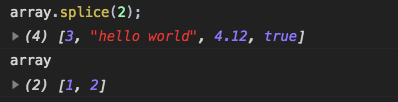
only index 0 and 1 are still there
В качестве еще одно примера, я указал 1 в качестве второго параметра: таким образом, каждый раз при повторе метода splice ( ) будет удалять по одному элементу, начиная со второго:
array.splice(2, 1);

Массив до метода splice ( )
Splice ( ) применен один раз:

Элемент 3 удален: следовательно, теперь элемент “hello world” имеет порядковый номер 2
Splice ( ) применен два раза:

На этот раз, был удален элемент “hello world”, потому что его порядковый номер 2
Так можно продолжать до тех пор, пока не останется элементов с порядковым номером 2.
The limit criteria
The second criteria that can be used in the split function can be used to set a limit to the number array elements that are stored when the string is split.
<html>
<body>
<script type="text/javascript">
// Create a variable that contains a string
var myString = "Mr. Jack Adams";
// Create a variable to contain the array
var mySplitResult;
// Use the string.split function to split the string
// using empty quotation marks as a criteria for splitting the string
mySplitResult = myString.split("", 6);
for(i = 0; i < mySplitResult.length; i++)
           {
  document.write("<br /> Element " + i + " of the array is: " +  |
      mySplitResult);
           }
</script>
</body>
</html>
|
The output of the above split function limited to six array elements can be seen below:
Element 0 of the array is: M Element 1 of the array is: r Element 2 of the array is: . Element 3 of the array is: Element 4 of the array is: J Element 5 of the array is: a |
As you can see from the above code examples. manipulating strings and splitting strings into various array elements is fairly simple using JavaScript.
As an object oriented language, JavaScript offers programmers the flexibility of working with objects, and yet JavaScript offers programmers the opportunity of working with a dynamic programming language that offers support for both functional and imperative programming styles.
JavaScript also allows for the creation of scripts for use by a large number of applications. JavaScript applications can be used in web pages, they can be embedded in PDF files and they can be used in Google widgets and applications like Google Docs. JavaScript can even be used to create stand alone applications using applications like Adobe Integrated Runtime which programmers use to build desktop applications using JavaScript.
Внутреннее устройство массива
Массив – это особый подвид объектов. Квадратные скобки, используемые для того, чтобы получить доступ к свойству – это по сути обычный синтаксис доступа по ключу, как , где в роли у нас , а в качестве ключа – числовой индекс.
Массивы расширяют объекты, так как предусматривают специальные методы для работы с упорядоченными коллекциями данных, а также свойство . Но в основе всё равно лежит объект.
Следует помнить, что в JavaScript существует 8 основных типов данных. Массив является объектом и, следовательно, ведёт себя как объект.
…Но то, что действительно делает массивы особенными – это их внутреннее представление. Движок JavaScript старается хранить элементы массива в непрерывной области памяти, один за другим, так, как это показано на иллюстрациях к этой главе. Существуют и другие способы оптимизации, благодаря которым массивы работают очень быстро.
Но все они утратят эффективность, если мы перестанем работать с массивом как с «упорядоченной коллекцией данных» и начнём использовать его как обычный объект.
Например, технически мы можем сделать следующее:
Это возможно, потому что в основе массива лежит объект. Мы можем присвоить ему любые свойства.
Но движок поймёт, что мы работаем с массивом, как с обычным объектом. Способы оптимизации, используемые для массивов, в этом случае не подходят, поэтому они будут отключены и никакой выгоды не принесут.
Варианты неправильного применения массива:
- Добавление нечислового свойства, например: .
- Создание «дыр», например: добавление , затем (между ними ничего нет).
- Заполнение массива в обратном порядке, например: , и т.д.
Массив следует считать особой структурой, позволяющей работать с упорядоченными данными. Для этого массивы предоставляют специальные методы. Массивы тщательно настроены в движках JavaScript для работы с однотипными упорядоченными данными, поэтому, пожалуйста, используйте их именно в таких случаях. Если вам нужны произвольные ключи, вполне возможно, лучше подойдёт обычный объект .
Split string in two on a given index
If you have a string that needs to split on the given index and then return both parts, separated by a comma. See the following code example.
// app.js

const splitData = (value, index) => {
  return value.substring(0, index) + "," + value.substring(index);
}

console.log(splitData('110470116021', 6));
Now, see the following output.
➜  es git:(master) ✗ node app
110470,116021
➜  es git:(master) ✗
In the above function, we have passed the two parameters the value and index.
We have used the Javascript substring() function and using that function, we have divided the two strings at the given index and then concat those strings and return the string.
How to Use JQuery?
JQuery is available in a JavaScript file containing everything to perform different web functions. The following code is how you add a jQuery library file to your web page:
<script type=”text/javascript” src=”jQuery-min.js”></script>
This type of markup is used under the tag of <head></head> within your web pages. However, it can be used in coding script wherever you want.
jQuery Split
JQuery’s library contains the function split() that is utilized to separate a string into an array. One main parameter you need to pass is the separator. The separator can be a hyphen, comma or a space.
Split (”): when you pass an empty string into the split method, it will then split every character in an array.
JQuery Split Syntax
There are different situations where you need to split a string within JavaScript such as if you want to loop each element passed in a string array as well. For a more comprehensive understanding of how jQuery split works, here are some basics.
The following is an example of jQuery split syntax:
String.split(‘’],); (it will return empty string as explained above)
String. split (,], ); (It will return a comma into the string where required)
String.split(-],); (it will return hyphen into string where required)
String.split(‘ ‘],); (it will return blank space by splitting words into an array)
As a result, the split method is passed to split characters into a substring array and passed to a new array. So, the basic syntax is like this: string.split(separator, limit)
It uses two parameters named as limit and separator. Let’s talk about it.
1. Separator – as mentioned above, it is used to denote where you want to separate the string. It is optional. If you omit the separator, it will return the entire string.
2. Limit – this is also optional, but it will return an integer type value that tells about the number of “splits” to be made.
Here are some examples of jQuery split:
Example One:
var element = ‘Rocks!!’;
var arrayOfStrings = element.split();
If you notice the above example, no separator is used. Therefore, the code returns arrayOfStrings variable.
Example Two:
var element = ‘Rocks star boy!!’;
var arrayOfStrings = element.split(” “);
In this example, you pass ‘space’ as a separator or delimiter to split a character or a string. So, arrayOfString will return three items.
arrayOfStrings = “Rocks”
arrayOfStrings = “star”
arrayOfStrings = “boy”
Example Three:
var element = ‘ Rocks star boy!!’;
var arrayOfStrings = element.split(” “,2);
In this above mentioned example, you pass a space as a separator or delimited to split the given string and also limit it as 2. Consequently, arrayOfString will return 2 items
arrayOfStrings = “Rocks”
arrayOfStrings = “star”
JavaScript VS JQuery
Since JavaScript’s introduction, it is the most expressive and powerful scripting language that works inside of web browsers in conjunction with CSS and HTML. It has become one of the most demanding programming languages on the Internet. All jQuery rules are linked by JavaScript. You must learn the basic fundaments of JavaScript to go a long way in knowing the structure of your code.
JQuery, in general terms, is not a programming language; it is a well written library based on JavaScript. As it is mentioned in the official web, “it is a concise and fast library of JavaScript that explains HTML using event handling, document traversing, Ajax interactions as well as animation for quick web development.” You can say that it is a ‘write less and do more’ library containing lightweight syntax for different functions on the web page.
The basic purpose of this code is to make the usage of JavaScript more precisely and easily on your web pages. There are many common tasks in jQuery that require long syntax using JavaScript to wrap into different methods that can be called with one line of code. It also helps a programmer with many complicated tasks found in JavaScript such as DOM manipulation and AJAX calls. It includes many features such as CSS manipulation, animation and effects, utilities, and event handling in HTML. For this reason, jQuery is the most extendable and popular script for many companies such as Microsoft, Netflix, IBM and Google.
How to split a string
Here are some examples of how to split various strings. Our first example will show you what happens when a string is split without specifying any criteria.
Take a look at the following code:
<html>
<body>
<script type="text/javascript">
// Create a variable that contains a string
var myString = "Mr. Jack Adams";
// Create a variable to contain the array
var mySplitResult;
// Use the string.split function to split the string
mySplitResult = myString.split();
for(i = 0; i < mySplitResult.length; i++)
  {
    document.write("<br /> Element " + i + " = " + mySplitResult);
  }
</script>
</body>
</html>
|
The output of the above set of code looks like this:
Element 0 = Mr. John Adams |
The reason that there is only one element within our array is because no criteria were specified within the split function itself.
The code uses the “for” loop to loop through the various elements of the array to be able to print each element. For a course on how to use the for loop and other programming loops in JavaScript, why not sign up for JavaScript fundamentals and learn how to use JavaScript to program for the web?
Массивы в JavaScript
Сперва нужно разобраться, как работают массивы JavaScript. Как и в других языках программирования, массивы используются для хранения нескольких единиц данных. Разница в том, что массивы JavaScript могут содержать несколько типов данных одновременно.
Чтобы работать с такими массивами, нам понадобятся JavaScript-методы: например, slice () & splice (). Создать массив можно так:
let arrayDefinition = []; // Array declaration in JS
Теперь создадим другой массив с данными разного типа:
let array = ;
В JavaScript можно создавать массивы с разными типами данных: с числами, строками и логическими значениями.
# What is Splitting?
Splitting is a JavaScript microlibrary with a collection of small designed to split (section off) an element in a variety of ways, such as , , , and !
The Splitting library does not handle any animation, but it gives you the elements and tools needed to create animations & transitions with JavaScript animation libraries or only CSS!. Most plugins utilize a series of s populated with CSS variables and data attributes that empower you to build all kinds of animations, transitions and interactions.
The general flow is:
- is called on a (see: )
- Create s to inject into , or query children of
- Index with CSS variables ( )
- Add the total to the target ( )
- Return an array of the splits (see: )
- Animate those elements with CSS or JavaScript!
# Installation
Why bother with build systems or files? Use the CodePen Template to make your own Splitting demo!
Using NPM
Install Splitting from NPM:
Import Splitting from the package and call it. The CSS imports may vary depending on your bundler.
Using a CDN
TIP
CDN use is only recommended for demos / experiments on platforms like CodePen. For production use, bundle Splitting using the with Webpack or your preferred code bundler.
You can get the latest version of Splitting off of the unpkg CDN and include the necessary files as follows.
Then call Splitting on document load/ready or in a script at the bottom the of the .
Recommended Styles
Included in the package are two small stylesheets of recommended CSS that will make text and grid based effects much easier. These styles are non-essential, but provide a lot of value.
- includes many extra CSS Variables and psuedo elements that help power advanced animations, especially for text.
- contain the basic setup styles for cell/grid based effects you’d otherwise need to implement yourself.
Browser Support
Splitting should be thought of as a progressive enhancer. The basic functions work in any halfway decent browser (IE11+). Browsers that support CSS Variables ( ) will have the best experience. Browsers without CSS Variable support can still have a nice experience with at least some animation, but features like index-based staggering may not be feasible without JavaScript.
The styles in for the rely on , so there may be additional browser limitations. In general, so you should be in the clear.
String Primitives and String Objects
First, we will clarify the two types of strings. JavaScript differentiates between the string primitive, an immutable datatype, and the object.
In order to test the difference between the two, we will initialize a string primitive and a string object.
We can use the operator to determine the type of a value. In the first example, we simply assigned a string to a variable.
In the second example, we used to create a string object and assign it to a variable.
Most of the time you will be creating string primitives. JavaScript is able to access and utilize the built-in properties and methods of the object wrapper without actually changing the string primitive you’ve created into an object.
While this concept is a bit challenging at first, you should be aware of the distinction between primitive and object. Essentially, there are methods and properties available to all strings, and in the background JavaScript will perform a conversion to object and back to primitive every time a method or property is called.
Ручная установка графического драйвера Nvidia тоже осуществляется несложно
В данном случае надо лишь скачать его с интернета и установить.
Важно! Скачивать драйвера необходимо только с официального сайта разработчика. Иначе рискуете словить вирусов и прочей гадости.

Запускаете файл и следуете инструкциям. Установка драйвера GeForce Nvidia осуществляется несложно, поэтому трудностей с этим не будет.
После завершения установки программа попросит перезагрузить компьютер (или ноутбук). Перезагружать можно не сразу, а в любое другое время (на случай, если у Вас открыты рабочие файлы, что-то скачивается или записывается). Но драйвер Nvidia будет полноценно работать только после перезагрузки.

concat
Метод concat возвращает
новый массив, состоящий из элементов текущего массива, плюс элементы, указанные
в качестве аргументов:
Array.concat(arg1,
arg2…)
Здесь arg1, arg2
могут быть как примитивными данными (строки, числа), так и массивами. Например:
let ar = 1, 2;

let res1 = ar.concat(3, 4); // 1,2,3,4
console.log( res1 );

let res2 = ar.concat(3, 4, 5, 6); // 1,2,3,4,5,6
console.log( res2 );

console.log( ar.concat(3, 4, 5, 6) ); // 1,2,3,4,5,6
По идее, этот
метод работает и с объектами, вот так:
let obj = {name "guest"};
let ar = 1, 2;
let res = ar.concat(obj);

console.log( res );
но здесь
копируется лишь ссылка на объект, а не он сам.